
BEHIND THE ART
Curating is often mischaracterized as a matter of selection: choosing what to show, where to place it, and how to explain it. While that may be part of the process, it does little to capture the depth of what curators actually do. Especially outside traditional institutions and museum walls, curating is not a checklist of tasks, but a meticulous composition of relationships: between artwork, space, and viewer. It is not about filling space, projecting taste, or validating value. It is rarely about directing attention, and never about controlling it.
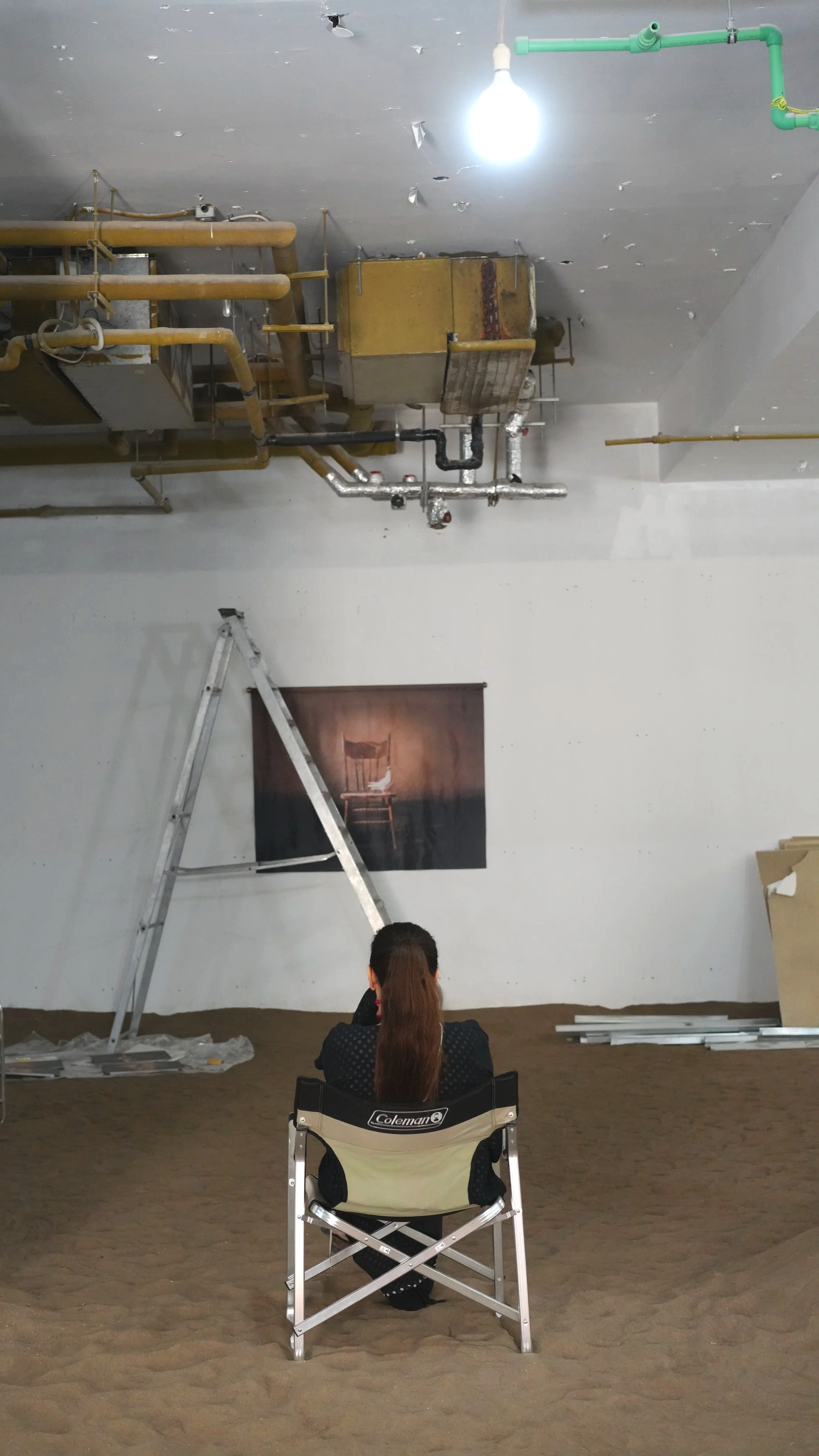
SARAB Behind The Scenes - Photo By Meera Macki
Curating is a process of translating instinct into structure. At its most thoughtful, it begins not with a theme or a message, but with a question, often one that hasn’t found language yet. The curator’s role is not to resolve that ambiguity too quickly, but to stay with it. To listen to the work, to the space, and to what might quietly emerge between the two.
This translation is rarely linear. It might involve mentally redrawing a floor plan to mirror how the eye moves through a space, or rewriting text until it suggests rather than instructs. It’s the work of noticing small imbalances and adjusting them until the room feels coherent without becoming uniform. At times, it’s about knowing when to intervene—and more often, when to hold back.
In group exhibitions especially, the work lies in shaping how distinct voices can coexist without competing, not by equalizing them, but by allowing each work to respond to the next in ways that are subtle, dynamic, and unexpected. It means finding a shared rhythm, a visual pacing, or a point of tension that gives the viewer a way in.
SARAB, the latest exhibition produced by RASMA Art and curated by founder Rasmia Noor Al Zadjali, brought together works by Khadija Al Maamari and Hajer Al Harrasi in a pairing that revealed its logic gradually, not on first glance. The connection between their practices was not immediately apparent. Their visual languages were distinct, but both circled themes of memory, absence, illusion, and the ache of what remains or slips away. Over time, a narrative arc began to take shape: fluid, unsettled, constantly subject to reinterpretation.
SARAB couldn’t be curated through certainty. It had to be developed through trust. Trust that the viewer would feel the work without being instructed, that the gaps between artworks could speak louder than any performance. It was curated emotionally, with measured care for equal moments of drift and convergence, rhythm and stillness.
There were structural challenges, too. The space didn’t exist but had to be created from scratch. Sand was brought in not as an aesthetic gesture, but as the exhibition’s spine: grounding the experience and physically altering how viewers moved through the room. Layers of fabric and netting were added to visually connect the works. A wall was constructed to achieve the scale and continuity the exhibition needed. Every choice, including the removal of a window, served the emotional rhythm of the exhibition.
The soundtrack received the same care as the spatial choreography. The lighting demanded rigorous calibration. Music was limited to piano, a playlist selected to underscore the mood, not dominate it. As visitors stepped onto the sand, Clair de Lune and Gymnopédies played softly, with nostalgic jazz interspersed.
In contrast, Kullon Mena in 2023, which brought together Safaa Erruas, Riham Noor Al Zadjali, and Elmira Abolhasani, began with clarity. The subject – displacement – was evident at the outset: in the works, the tone, and the intention. The curatorial task was not to create cohesion, but to honour the intensity already present, to give it structure without softening its impact.
The space was identified early on and immediately felt right. A raw, uninhabited structure by the seafront promenade overlooking the Gulf of Oman in Muscat, it offered a rare balance of architectural character and emotional openness. But the transformation was demanding; Weeks of labor went into clearing debris, deep cleaning, and restoring the building’s integrity. That process of reclamation became part of the exhibition’s rationale: a framework shaped as much by persistence as by vision.
The space was otherwise left largely intact save for a few interventions. A room was darkened for the video art. Another piece, originally designed for the floor, was suspended from the ceiling instead. A transparent tent was placed in a glass-walled room. These decisions required negotiation, intuition, and ultimately, trust between curator and artist.
Small details held the narrative together: dried plants retrieved from dumpsters, rusted barrels, a vintage suitcase from the past century, and scattered personal items like combs and nail clippers in clear vases. These objects were not decorative. They were used to suggest the everyday nature of loss, the items left behind when people are forced to flee.
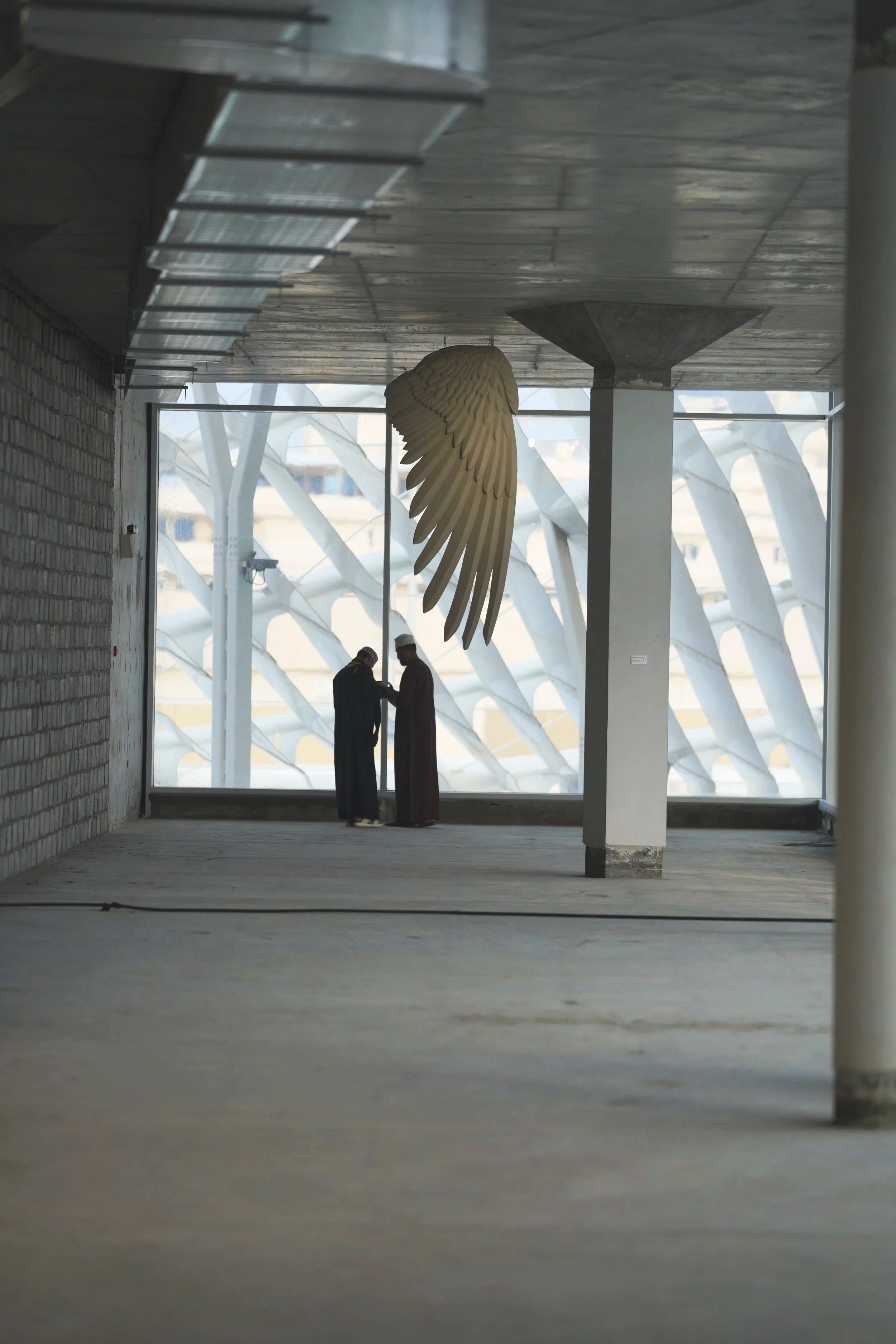
Kullon Mena Exhibition - Photo By Meera Macki
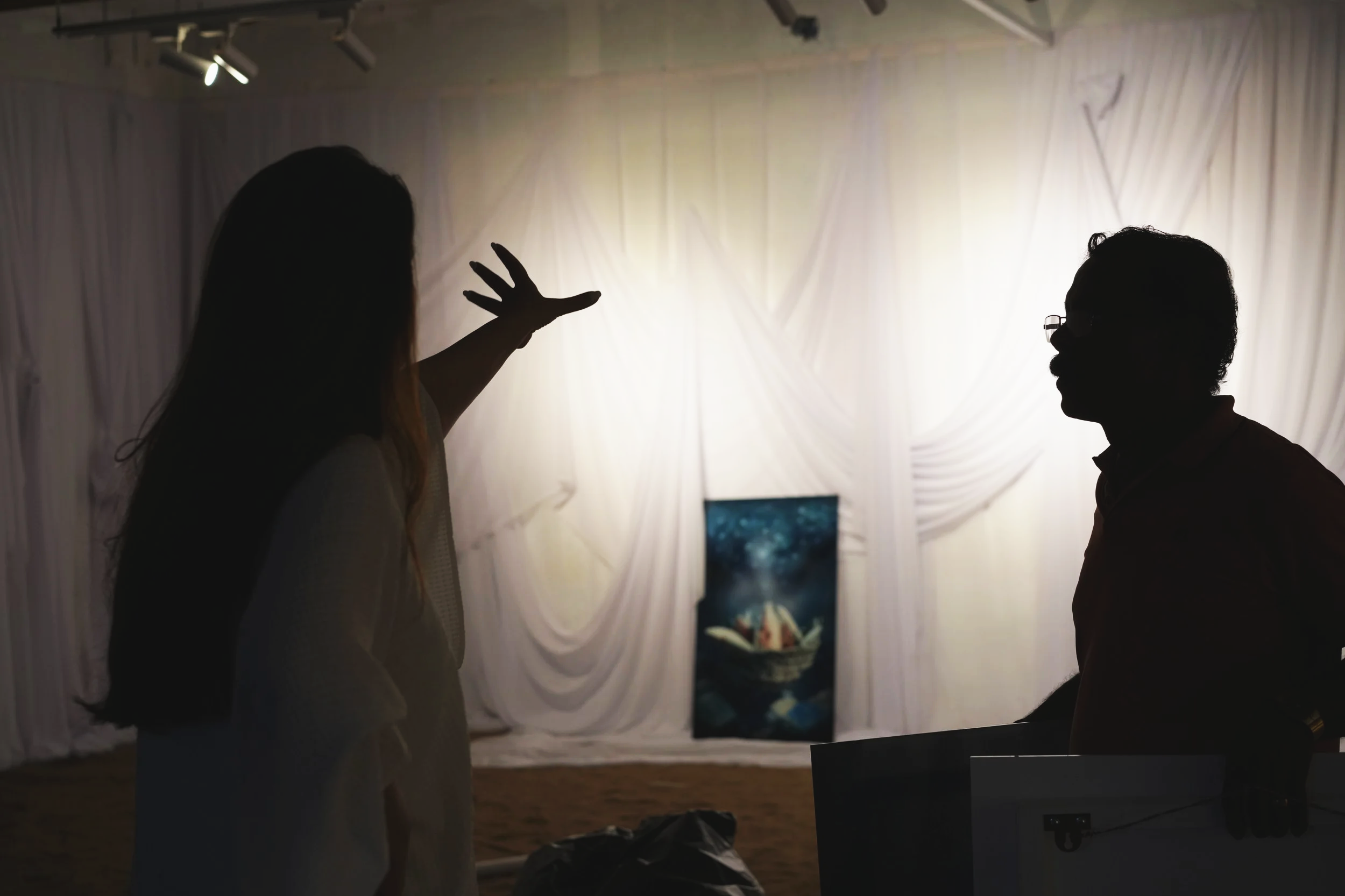
SARAB Behind The Scenes - Photo By Meera Macki
At its most potent, curation recedes into the background, barely leaving its fingerprints. A skillful exhibition does not hand its meaning to the viewer; it offers a lens, a pause, a moment of stillness where meaning can take root.
This is the heartbeat of RASMA Art. Our exhibitions and publications are not static frames but living spaces. Every wall, page, and placement is an invitation to look closer, think deeper, and connect differently.
If this philosophy resonates with you, stay close. There’s always more to come.
Music, again, held its own emotional charge. Patriotic and nostalgic songs filled the space, triggering collective memory and grounding the works in a sonic landscape that was both political and intimate.
Curation is an alchemy of vision and form, a dance between concept and space. Each choice and every encounter – whether it is the path a visitor follows, the balance between closeness and separation, the way an artwork catches the light – orchestrates an invisible choreography.